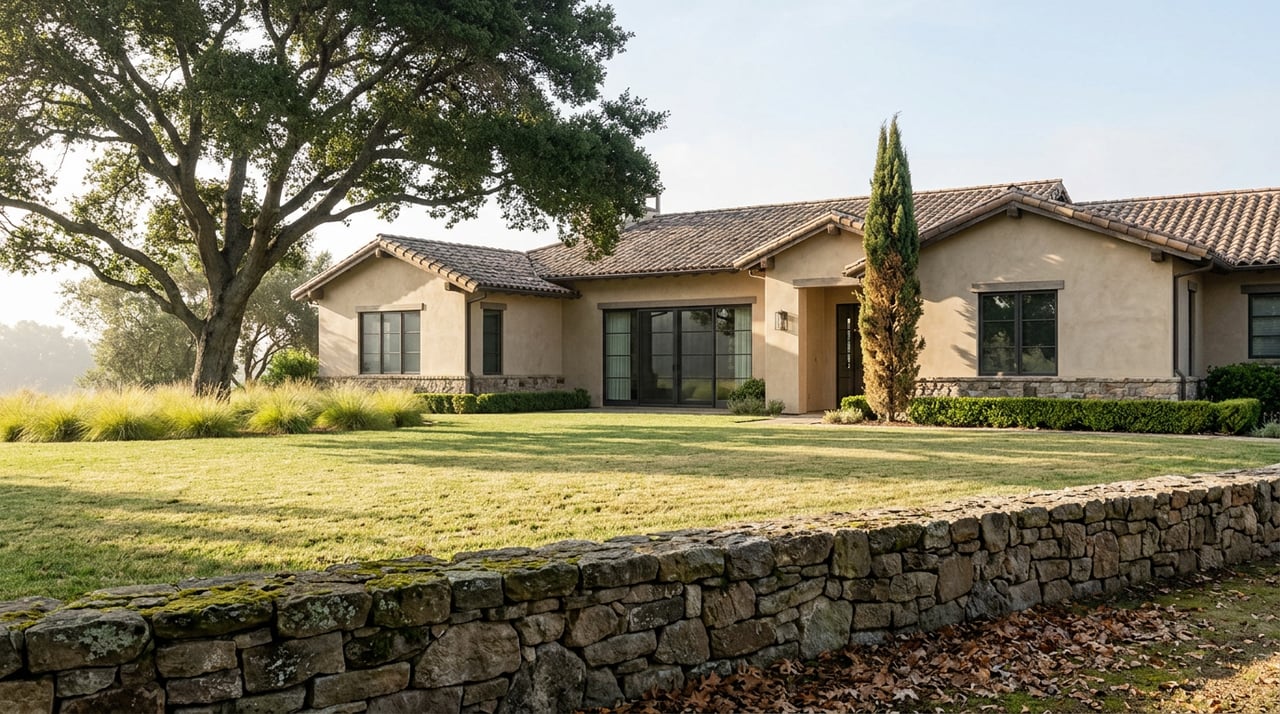
Buyers who pay cash for a Woodside estate tend to assume they have also bought their way out of the usual rural-property paperwork. No lender measuring the distance between a wellhead and a septic tank. No appraiser demanding a water test before closing. That assumption holds up reasonably well. Conventional lenders typically skip well and septic inspections altogether unless an appraiser or another party flags a problem, and a cash buyer answers to no lender at all.
None of that has anything to do with what happens the day you decide to add a primary suite.
San Mateo County's Onsite Systems Manual sets a threshold that has nothing to do with financing and everything to do with permits. Once a remodel reaches 50 percent of the value of a structure served by a septic system, or once it adds a single bedroom, the entire onsite wastewater system has to meet current county standards before the county will sign off on the work. Not the old tank grandfathered in from the 1970s. Not the leach field sized for a three-bedroom ranch that is about to become a five-bedroom estate. The current standard, which can mean a larger tank, additional leach trenches, and a fresh round of percolation testing on the same lot that has to absorb all that new water.
This is the number that actually caps a Woodside renovation, and it shows up long after the financing question has been settled.
Why This Bites Harder in Woodside Than Almost Anywhere Else on the Peninsula
Woodside is a town of historic ranches and 1950s-era houses along Woodside Road and Canada Road standing next to contemporary estates on multi-acre wooded parcels, and most of that housing stock runs on private septic. That combination, older homes with modest original footprints on land that people buy specifically to expand, is exactly the setup where the 50 percent trigger gets pulled.
A buyer who falls for a 1958 ranch on two wooded acres and plans to double the square footage is not just budgeting for framing and finishes. They are budgeting for whatever the leach field needs to become, on a lot where mature oaks, slope, and setback rules may leave very little room to relocate a drainfield. San Mateo County requires a licensed percolation tester and a permit application with three surveyed plot plans before any of that work can even be evaluated, and the process is not fast. A remodel that looked like an architect's problem in month one can turn into a soil engineering problem in month four.
None of this is a defect specific to any one property. It is the physics of a private wastewater system meeting an ambitious floor plan, and it applies whether the buyer closes with a jumbo loan or a wire transfer.
Not Every Woodside Address Sits on the Same System
The other assumption worth checking before you get attached to a listing is that "Woodside" automatically means septic. It does not. The town has three distinct piped sewer service areas layered into an otherwise septic-default landscape.
| Sewer service area | Who operates it | What it means for a buyer |
|---|---|---|
| Town Center Sewer District | Town of Woodside | Piped sewer, no septic system to evaluate |
| Fair Oaks Sewer District | County of San Mateo | Piped sewer, county-operated |
| Redwood Creek Sewer District | County of San Mateo | Piped sewer, county-operated |
| Everywhere else in unincorporated San Mateo County | Private septic | The 50 percent remodel rule applies |
West Bay Sanitary District, which serves Menlo Park, Atherton, and Portola Valley outright, does not run Woodside's sewer system directly. It maintains those Town Center, Fair Oaks, and Redwood Creek mains under a service contract with the town and county. A buyer touring a listing near Woodside's small commercial core may be inside one of these piped districts without realizing it, while a buyer touring an estate a half mile up Kings Mountain Road is almost certainly on private septic with the county's 50 percent rule waiting in the background.
The only way to know which side of that line a specific parcel falls on is to ask, in writing, before you get emotionally invested in a floor plan that assumes unlimited expansion.
What to Confirm Before You Write the Offer
A few questions answer most of what matters here, and none of them require a lender's involvement to ask.
- Is this parcel inside the Town Center, Fair Oaks, or Redwood Creek sewer district, or is it on private septic. The town's sewer services page lists which district serves which streets.
- If it is on septic, what is the system's rated capacity, and how much of that capacity does the current bedroom count already use.
- Does the renovation you are picturing, in square footage or added bedrooms, approach the 50 percent threshold on the structure's assessed value. If so, budget time and money for a full OWTS upgrade, not just a permit fee.
- Is there physical room on the lot for a larger leach field once setbacks, slope, and mature trees are accounted for. This is a site question a percolation tester answers, not something you can eyeball from the driveway.
- Has the septic system been inspected recently. California law requires an inspection of any onsite system at the time of sale, independent of loan type, so ask for that report rather than assuming a cash deal means no one has looked.
None of this should discourage anyone from an estate with room to grow. Plenty of Woodside properties absorb a significant addition without tripping the 50 percent line, particularly when the existing system was already sized generously or the addition stays modest. The point is to know where a specific lot sits on that spectrum before the offer goes in, not after the architect's plans are done.
A Short FAQ
Does the 50 percent rule apply if I am not adding a bedroom? Yes, if the remodel's value reaches 50 percent of the existing structure's value, the full septic system has to meet current county standards regardless of bedroom count. Adding a bedroom triggers the same requirement on its own, even in a smaller remodel.
If I am paying cash, do I still need a septic inspection? California requires an inspection of any onsite septic system at the time of sale. That requirement comes from state law, not your lender, so a cash purchase does not remove it.
Is a home in the Town Center Sewer District exempt from any of this? Yes. A property on piped sewer has no septic system for the county rule to apply to. The distinction only matters for the parts of Woodside still running on private systems, which is most of the town outside its small sewered pockets.
If you are weighing a Woodside estate with renovation in mind, the conversation about lot capacity and system limits should happen before you write an offer, not after. Adriana Trenev has spent fifteen years advising buyers and sellers across the Mid-Peninsula's estate properties, including the due diligence that separates a straightforward remodel from a costly surprise. Schedule a consultation to talk through what a specific Woodside property can and cannot absorb.