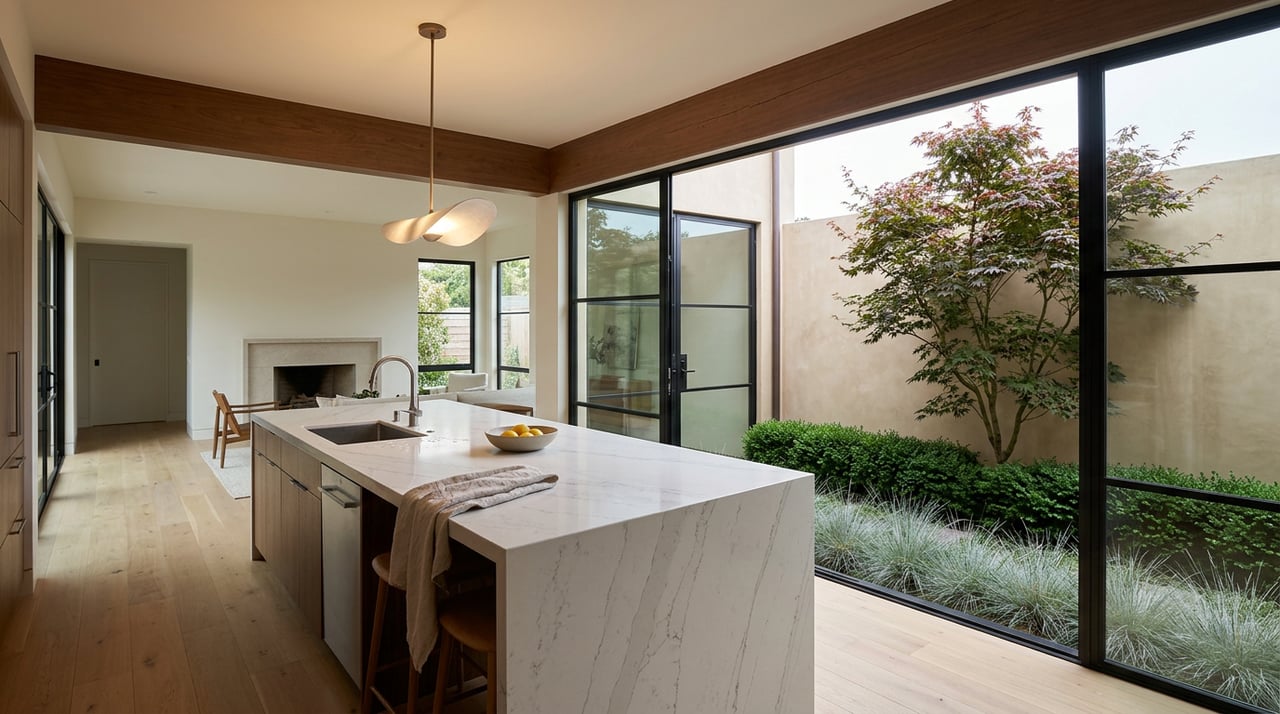
Every Eichler buyer I work with walks in for the same reasons: the walls of glass, the atrium pulling light into the center of the plan, the sense that the house was designed to disappear around a courtyard rather than sit on a lot. Those are the details that get discussed in escrow. The detail that actually determines what a buyer will spend over the next ten years rarely comes up at all, because it is poured into the slab and invisible until it fails.
I am talking about the radiant heating system, and more specifically, the material of the pipe running through it. A standard home inspection in Palo Alto checks the roof, the panel, the plumbing fixtures, and the grading around the foundation. It does not, and cannot, evaluate a hydronic system embedded in concrete. That gap is not a flaw in the inspection process. It is simply outside a general inspector's scope, which means the buyer who assumes a clean inspection report means a clean slab is working from the wrong assumption entirely.
What a Standard Inspection Actually Covers, and What It Skips
A general home inspector walks through roughly the same checklist on any 1950s or 1960s Palo Alto property: electrical panel capacity, visible plumbing, roof condition, windows, and structural signs like cracked stucco or doors that no longer close cleanly. On an Eichler, that checklist still matters. It just stops short of the one system unique to these homes.
The radiant heat running through an Eichler's slab is hydronic, meaning copper or steel tubing carries hot water beneath the finished floor. Evaluating whether that tubing is intact requires pressure testing and leak detection equipment that a general inspector does not carry and is not licensed to use. That work falls to hydronic heating specialists, and firms that do this work across the Bay Area, including Anderson Radiant Heating in Campbell, treat it as a distinct trade with its own pressure-testing protocol and leak-location equipment precise enough to find a single drop of water regardless of how deep the tubing sits.
If a seller's disclosure says the radiant system works and the general inspection report is silent on it, that silence is not a clean bill of health. It is simply a system nobody looked at.
According to Anderson Radiant Heating, homeowners who file a claim for a radiant leak have the right to choose their own contractor rather than accept whichever name an insurer's investigative agency suggests first. That choice matters, because a contractor unfamiliar with in-slab hydronic systems can turn a contained repair into a much larger one.
The Question That Actually Predicts Your Cost: Copper or Steel
Here is the detail that separates a manageable repair from a five-figure one, and it has nothing to do with the home's age, its tract, or how well the kitchen was updated. It comes down to what the original contractor used to pipe the slab.
Copper tubing, installed in most Eichlers, holds up for decades in a closed hydronic loop because copper does not corrode inside sealed piping. Steel tubing, more common in homes built during the early 1950s when copper was scarce due to wartime demand, behaves very differently. Once a steel line starts to leak, it is generally not repairable. The standard response is full replacement rather than a spot fix.
That distinction shows up directly in what owners pay:
| Scenario | Typical Cost |
|---|---|
| Contained leak repair, copper piping | $1,250 to $2,500, rarely exceeding $7,500 in difficult cases |
| Full system replacement, typically after steel piping fails | $20,000 to $40,000 or more |
A buyer comparing two similarly priced Eichlers in Greenmeadow and Fairmeadow could be looking at a fifteen-thousand-dollar swing in future cost of ownership based on the material used for the tubing. Neither the listing photos nor the general inspection report will tell you which one you are buying.
The Insurance Wrinkle Worth a Phone Call
A burst radiant line is often treated by homeowner's insurance as sudden accidental water damage, and contractors who handle these claims regularly report that carriers will typically reimburse around 90 percent of the repair cost as non-plumbing work, leaving the homeowner responsible for the plumbing portion and the deductible. That is meaningful protection if your system ever fails.
It is not universal protection. Some insurers have started excluding radiant panel leaks from coverage entirely. If you are close to removing an inspection contingency on an Eichler, a five-minute call to your insurance agent to confirm how your specific policy treats slab leaks is worth more than almost anything else you could do that week.
Two Other Things Buyers Confuse With Bigger Problems
Two questions come up often enough in Eichler transactions that they deserve a direct answer, because getting them wrong wastes real time during a search.
The first is whether a given Eichler sits inside a historic district. Most do not. What many Palo Alto Eichler tracts do carry, including Greenmeadow and Green Gables, is a Single-Story Overlay, a zoning designation that legally prevents a second-story addition regardless of what standard R-1 rules would otherwise allow. That is a planning restriction, not a historic designation, and the two get confused constantly. The City of Palo Alto's Eichler Neighborhood Design Guidelines lay out which tracts carry which protections, and it is worth checking before you fall in love with an addition that the zoning will never allow.
The second is permit history. Eichlers have been remodeled for seventy years, and the additions that create problems at closing are consistently the ones that never went through the city. Unpermitted work that alters the post-and-beam structure or encloses an atrium without proper support does not usually show up in a photo. It shows up later, as a title question, an insurance complication, or a lender who wants extra inspections before funding. Pulling permit history before writing an offer, rather than after an inspection report raises a flag, puts you in a stronger negotiating position either way.
What This Means If You're Pricing an Offer
By late 2025, a livable, entry-level Eichler in Palo Alto had settled above roughly $3.1 million, with turnkey homes in Midtown and Greenmeadow trading between $3.2 million and $3.7 million. At that price point, a fifteen to twenty thousand dollar difference in likely heating system cost is not a rounding error. It is a number worth building into your offer strategy the same way you would factor in a dated kitchen or an unfinished bathroom.
Before you remove a contingency on any Palo Alto Eichler, I would ask for three specific things: a pressure test from a hydronic specialist rather than a general inspector's opinion, a call to your insurance agent about how your policy treats slab leaks, and a pull of the city's permit file for any work that touches the structure. None of those steps are dramatic. All three are the difference between buying a home you understand and buying one you are hoping about.
A Few Questions Worth Asking Directly
Does my general home inspection already cover the radiant system? No. General inspectors evaluate visible and accessible components. A hydronic system embedded in a concrete slab requires pressure testing that falls outside a standard inspection's scope, which is why a separate specialist evaluation is standard advice from people who work on these systems regularly.
Will insurance pay if the system fails after I move in? Often, yes, for the non-plumbing portion of a repair tied to sudden water damage. But coverage varies by carrier and some insurers now exclude radiant leaks specifically, so confirm your policy's language before you rely on it.
If my Eichler has a Single-Story Overlay, does that mean it's historic? No. Overlay zoning and historic designation are two separate questions with two separate answers. An overlay restricts building height regardless of a home's historic status, and a home can carry one, both, or neither.
Palo Alto's Eichler stock is not going to grow. Roughly 2,700 of these homes exist across the city, spread through tracts built between the early 1950s and the 1970s, and that scarcity is part of what keeps demand steady even when the rest of the market cools. If you are searching in this segment, the difference between a smooth purchase and an expensive surprise usually comes down to which questions you ask before you write the offer, not after.
If you are weighing an Eichler purchase or preparing one for sale, I would welcome the chance to walk through what a specific tract, model, or slab history means for your plans. Adriana Trenev works across Palo Alto's Eichler neighborhoods and the broader Mid-Peninsula with exactly this kind of detail in mind. Schedule a Consultation to start the conversation.
This article is general information, not legal, tax or financial advice. Consult a qualified professional about your situation.